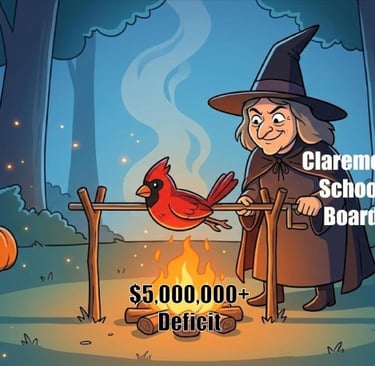
Pay no attention to the School Board behind the curtain...
On March 10, the School Board wants voters to pass another budget with a dramatic increase in per student spending. They say that is reasonable, but it’s not.
What the School Board doesn’t want to say out loud
Every October 1, all school districts in New Hampshire do a “school census.” Each district counts the number of students currently enrolled. This gives everyone an estimate of how many students (the ADM-R) the district will be paying to educate for the year. Normally the October enrollment is close to the ADM-R numbers that come out after the fiscal year closes.
On October 1, 2024, 1,534 students were enrolled in Claremont.
On October 1, 2025, 1,376 students were enrolled, 158 students less than the year before. That’s over a 10% decrease.
Don’t look behind the curtain
Here’s why the School Board won’t mention the decreasing enrollment.
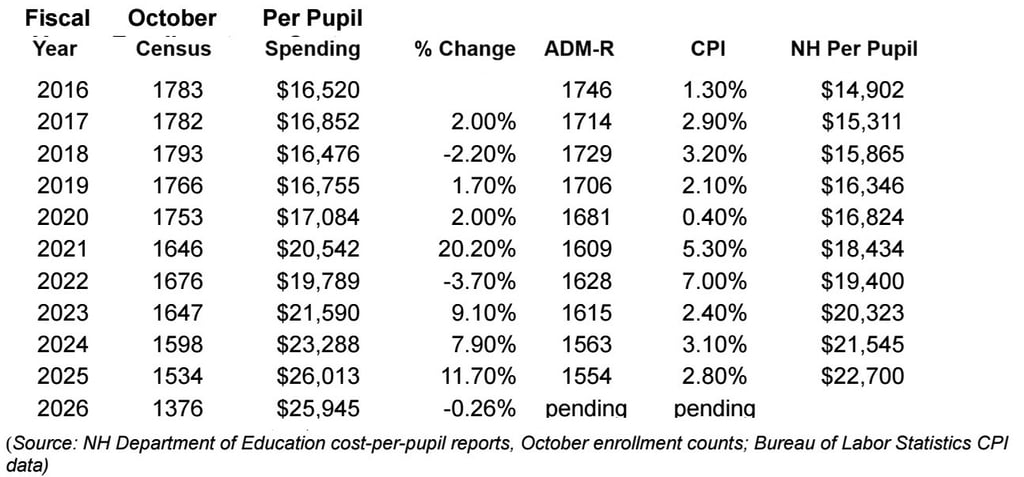
1. Over the last five years, the per pupil spending has risen much faster than the rate of inflation. Notably, the schools were losing about 20 students per year from 2017 – 2025.
2. The budget that is coming up for a vote on March 10 spends 20% more per pupil than the 2024-2025 budget. And the 2024-2025 per pupil spending was higher than the 2023-2024 budget by almost 8%. And the year before that, per pupil spending went up 9%. In fact, since 2020, spending has been rising far ahead of inflation, as shown in the table below.
3. The proposed budget for 2026-2027 is $42,957,713. If there are still 1,376 students next year, the cost per student will be over $28,000. (Cost per student = Total expenditures minus transportation and tuition expenditures. Transportation isn’t affected by the spending cap, so it makes no sense to claim that the spending cap will cause a cut in transportation.)
4. Those 158 students probably are gone forever. Some got EFAs (Education Freedom Accounts) and could suddenly afford other (better) schools. Some made the switch to charter schools; some went to micro-schools and home-schooling—and almost all families in Claremont are eligible to get EFA grants or Children’s Scholarship Fund grants.
What the School Board is selling
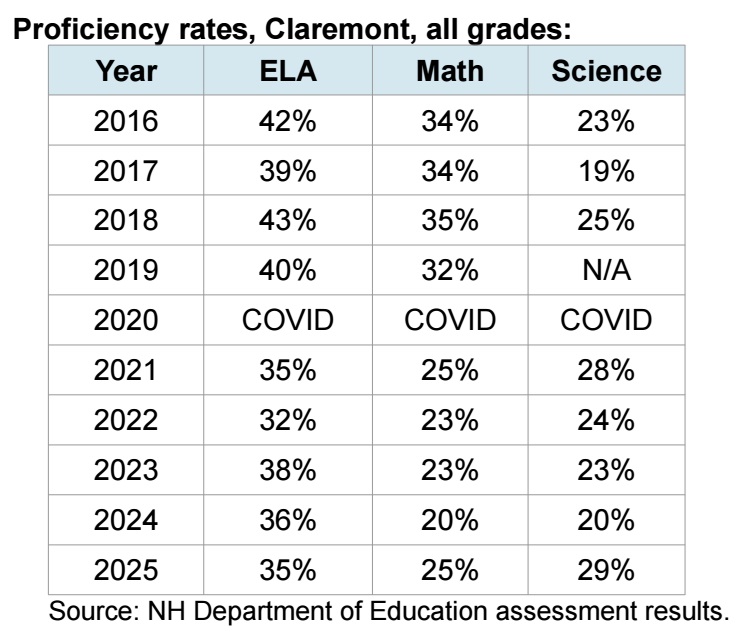
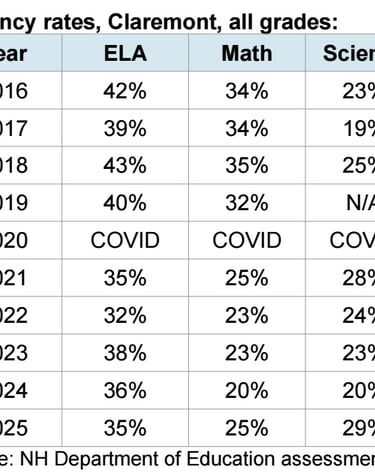
Every year, the New Hampshire Department of Education tests student proficiency in English Language Arts (ELA), Math and Science. Claremont schools rank in the bottom quarter of all schools in New Hampshire. Claremont homeowners and renters are paying for this:
“The sky is falling...”
For the first time this century, Claremont voters can limit per student spending increases to the rate of inflation. That is what Warrant Article 8, the spending cap, accomplishes.
The first budget that it will apply to will be the 2027-2028 budget. The spending cap will be the spending per student in 2025-2026 ($25,945) plus an adjustment for inflation. If inflation is 3% this year, then the total per student spending will be $25,945 + $778 = $26,723.
If the School Board doesn’t think that $26,723 is enough, they can ask the voters for more. The voters would have to approve this request by a 60% margin. It’s not a problem for most school districts in New Hampshire, whose budgets often pass by margins well above 60%.
However, our not-so-trustworthy School Board has claimed that they can’t do accounting. That’s believable, since they can’t seem to do basic arithmetic. Instead, they use fear tactics to scare voters. Thus a spending cap will encourage them to conduct business in the open, and to realize that they must convince voters that they are good caretakers of both tax money and the children entrusted to them. It’s ironic that the School Board wants the voters to trust them again after the financial fiasco, when they are so obviously unwilling to trust the voters.